
For many years, the F&I Log has been regarded as one of the most valuable sources of management information within a dealership. It has traditionally been used to measure finance penetration, product performance, income per unit and adviser productivity, providing valuable benchmarking data against internal targets and industry averages.
Whilst these metrics undoubtedly have their place, the motor industry now has an opportunity, and perhaps an obligation, to rethink the role of the F&I Log.
With the introduction of the FCA's Consumer Duty and an increasing emphasis on evidencing good customer outcomes, the purpose of the F&I Log should evolve from being primarily a performance measurement tool into a broader governance and management information framework that supports compliant growth.
Performance should be the outcome, not the objective
Historically, F&I Logs have often been viewed through a commercial lens. Management teams have understandably focused on finance penetration, product sales, commission income and profitability as key indicators of success.
However, this approach can inadvertently encourage businesses to judge the effectiveness of their F&I operations almost exclusively by financial performance.
Consumer Duty invites us to look at success differently.
Rather than asking, "How many products did we sell?", perhaps we should first be asking:
- Are customers consistently being introduced into the F&I process?
- Are referral standards being followed across every department?
- Are advisers delivering a consistent customer journey?
- Are product recommendations appropriate and aligned to customer needs?
- Are there emerging trends that could indicate risks to customer outcomes?
- Are we using our management information to identify training needs before they become compliance issues?
These questions place the customer journey, governance and process quality at the centre of decision making. Commercial performance should naturally follow when those foundations are strong.
The untapped value of F&I management information
Every F&I Log contains an enormous amount of operational intelligence.
Each customer interaction contributes to a wider picture of how a dealership is performing, not just commercially, but operationally and compliantly.
When that information is analysed effectively, it becomes possible to monitor quality measures and F&I penetration in context, such as product bias and suitability trends, the consistency of customer journey, departmental and adviser variations and changes in consumer behaviour patterns. All of which could potentially highlight emerging compliance risks and allow for coaching and continuous improvement opportunities.
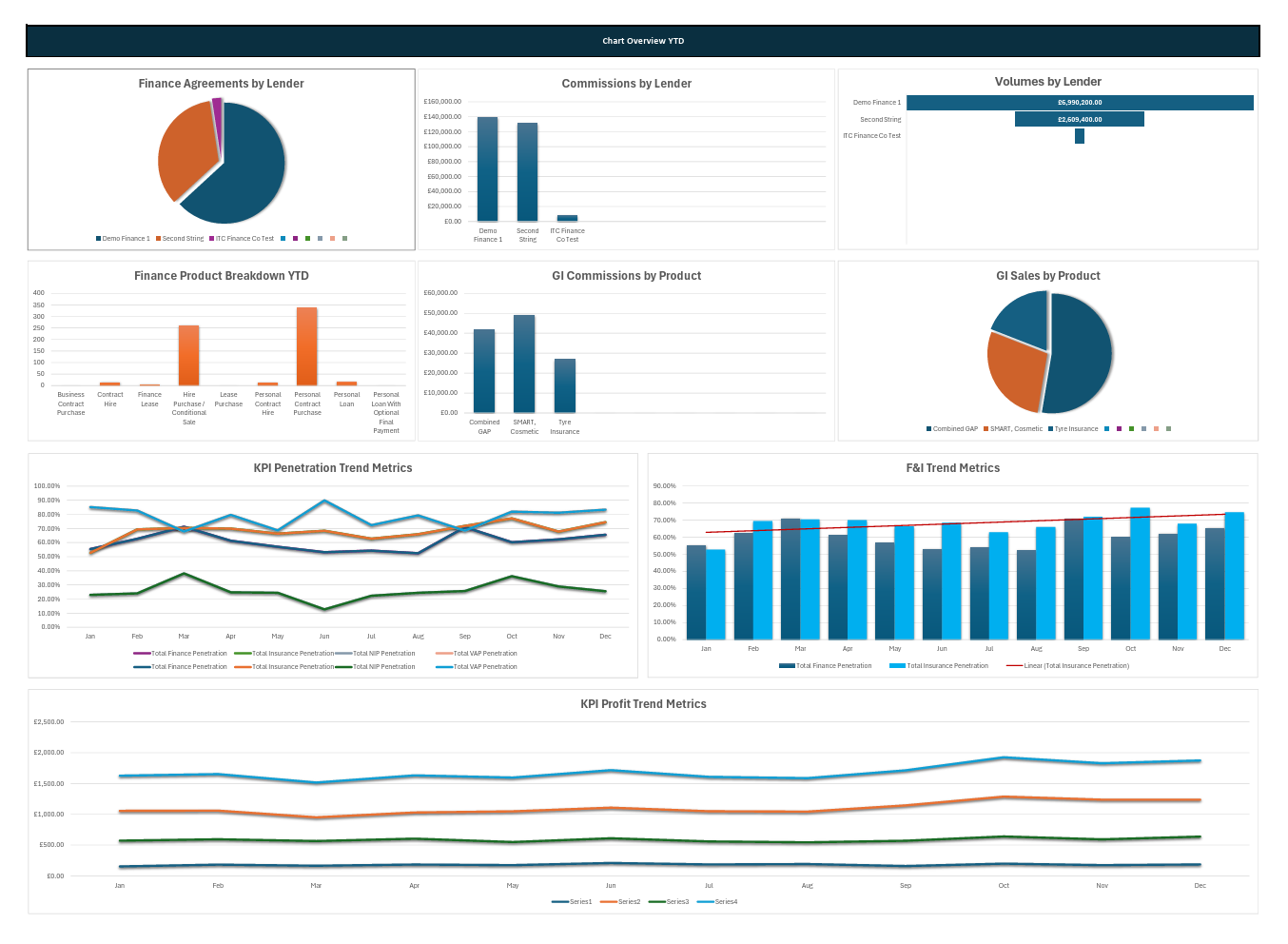
Furthermore, viewed in isolation, a single month's report offers only a snapshot. However, when data is analysed over time, it begins to tell a far more meaningful story.
Click the image below to see more.
 Using trend analysis to support good consumer outcomes
One of the greatest opportunities lies in moving beyond static monthly reports towards continuous trend analysis.
Monitoring performance over time enables leadership teams to identify subtle changes in behaviour long before they become significant issues.
For example, a gradual decline in referral rates may indicate weaknesses in the sales process. Changes in product mix could highlight evolving customer needs or inconsistencies in adviser recommendations. Variations between departments or sites may reveal opportunities to share best practice or target additional coaching.
Equally, consistent improvement across key indicators can provide assurance that governance frameworks, training initiatives and customer engagement strategies are delivering the desired outcomes.
This is where management information becomes a powerful compliance tool rather than simply a performance dashboard.
Forecasting more than profit
Forecasting has traditionally centred on revenue, finance income and product sales.
However, the same data can help businesses forecast operational performance and compliance risk.
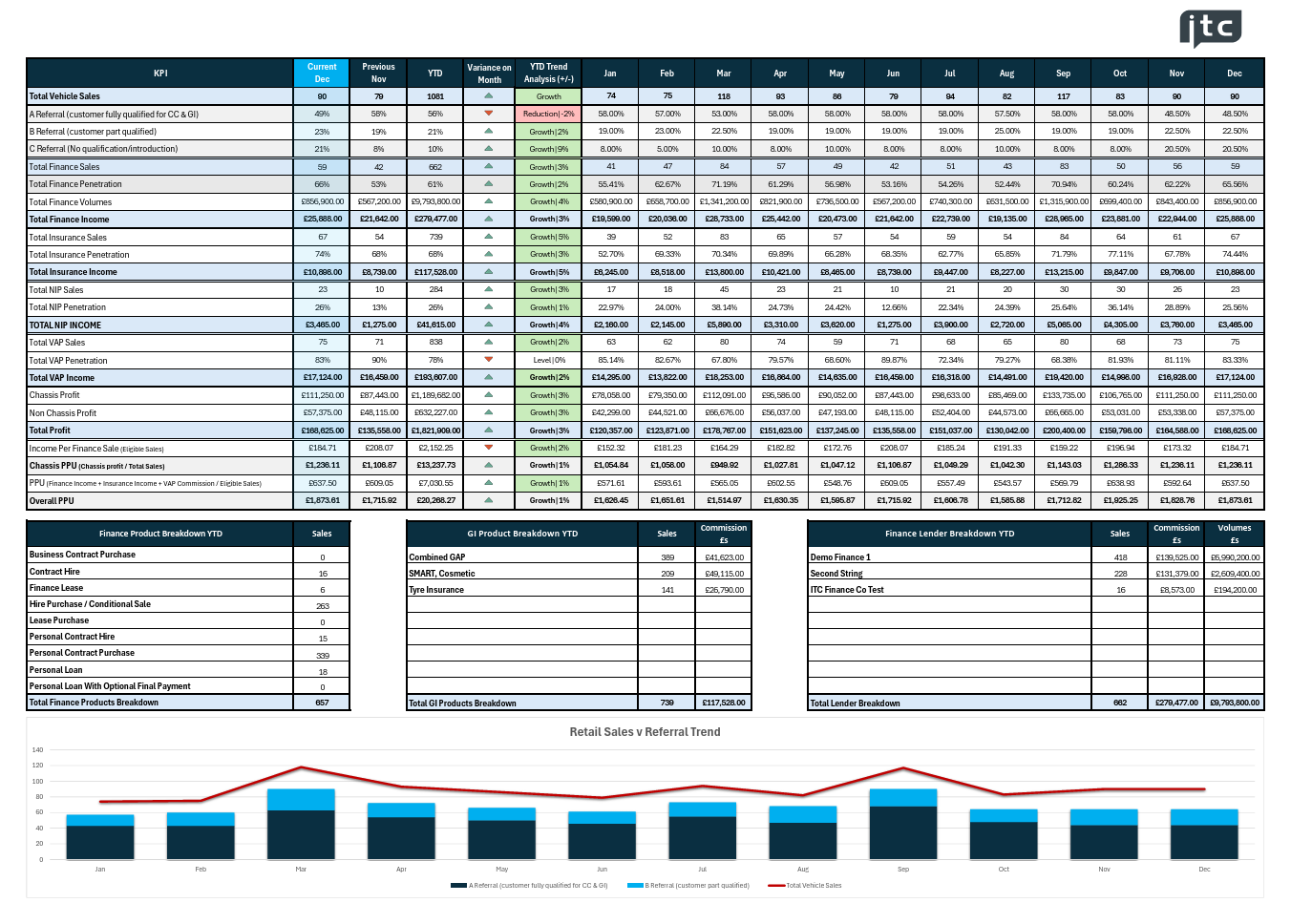
By analysing historical trends and year-to-date performance, dealerships can anticipate seasonal fluctuations, identify future training requirements, assess operational capacity and recognise emerging risks before they affect customer outcomes.
Forecasting therefore becomes a mechanism for proactive governance, enabling leadership teams to make informed decisions that balance commercial objectives with regulatory responsibilities.
Click the image below to see an example of an F&I log.
 Compliance and commercial success are not opposing forces
There remains a misconception that focusing on compliance somehow comes at the expense of performance.
In reality, the opposite is often true.
A dealership that consistently delivers a fair, transparent and customer-focused sales process is more likely to build trust, strengthen customer relationships and achieve sustainable commercial success.
- Strong governance creates consistency.
- Consistency improves customer confidence.
- Customer confidence supports long-term performance.
The most successful businesses will increasingly be those that recognise these outcomes are interconnected rather than competing priorities.
A new perspective on the F&I Log
The F&I Log should no longer be viewed simply as a record of sales activity or a league table for benchmarking performance.
It should be recognised as a strategic management information asset—one that provides leadership teams with real-time insight into customer journeys, operational consistency, emerging risks and business performance.
When supported by meaningful dashboards, year-to-date reporting and trend analysis, the F&I Log becomes far more than a compliance record. It becomes an early warning system, a governance tool and a framework for continuous improvement.
Ultimately, the question should no longer be, "How is our F&I team performing?"
Instead, we should ask, "What is our F&I data telling us about the quality of our customer outcomes, and how can we use that insight to improve?"
If the motor industry embraces that shift in thinking, the F&I Log will no longer be seen as a retrospective measure of performance. It will become one of the most valuable tools available for delivering compliant growth, supporting Consumer Duty and creating better outcomes for customers and businesses alike.
